

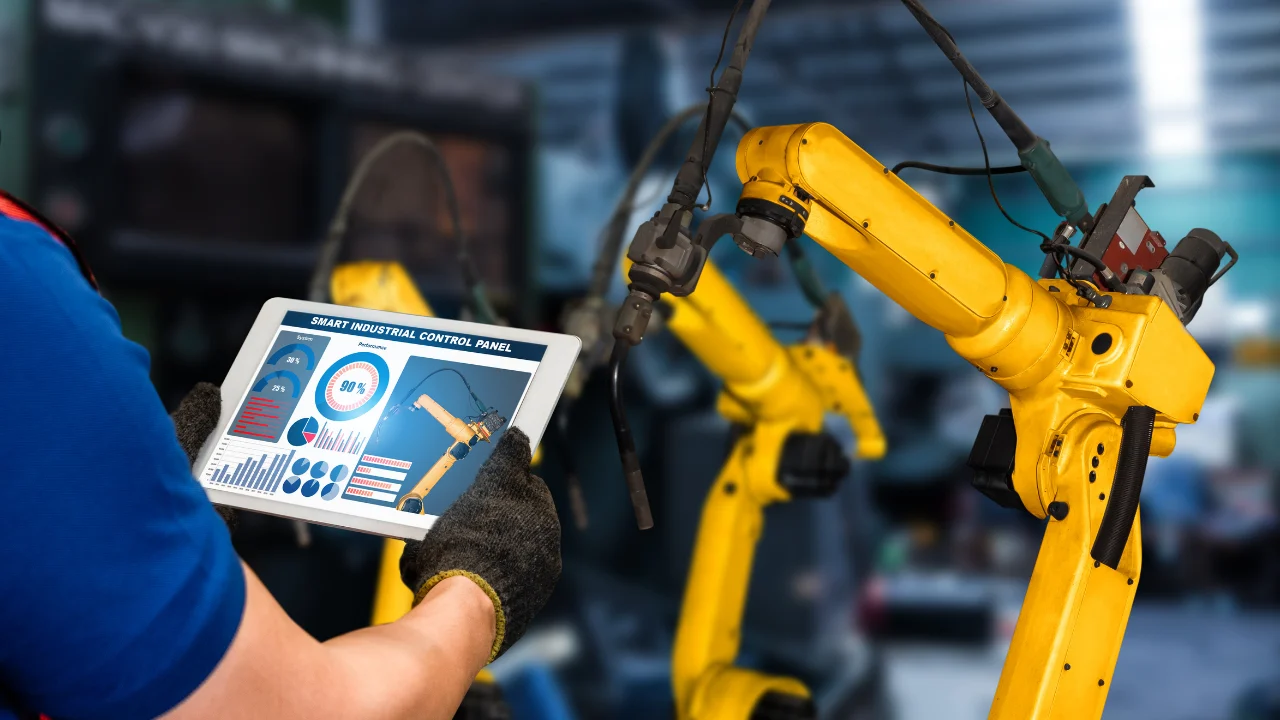
Your biggest competitors are making infrastructure decisions that will determine market leadership for the next 10 years.
Some are clinging to legacy systems, hoping to squeeze another year from equipment installed when flip phones were cutting-edge technology. Others are transforming their operations into intelligent, self-optimizing environments that will dominate their industries.
The gap between these two paths is widening every day, and it’s about to become insurmountable.
Industrial infrastructure is experiencing more than just an upgrade. It’s being revolutionized by the convergence of technologies that were once regarded as science fiction. Facilities now predict their own maintenance needs, optimize energy consumption in real-time, and adapt to changing conditions without human intervention.
But here’s what most executives don’t realize: This transformation window is rapidly closing. The companies moving now will capture 3- to 5-year competitive advantages. Those waiting for “better timing” will find themselves permanently locked out of the benefits, watching from the sidelines as smarter competitors dominate their markets.
The opportunity
The convergence of information technology (IT) and operational technology (OT) is creating powerful and unprecedented opportunities to break down data silos and optimize industrial facilities to dramatically increase productivity, efficiency, and resiliency.
Intelligent, connected solutions and automated systems hold the key to solving the toughest infrastructure challenges you face today, from aging equipment and legacy systems, to intensifying cost pressures and complexity, to distributed operations and changing workforce needs, to evolving regulatory mandates and beyond.
These advanced technologies are also fundamentally redefining how organizations operate and create value. Imagine infrastructure that thinks ahead. By combining IoT sensors, AI analytics, and real-time monitoring, you can create spaces that adapt to people’s needs before they ask. Facilities become more than just buildings – they transform into intelligent environments that save energy, reduce costs, and create better experiences for everyone inside. From smart cities to connected workplaces, these innovative systems and solutions can power data-driven decisions that improve daily operations while building a more sustainable future.
Success depends on implementing practical innovation that delivers real-world results right now, while driving sustainable transformation. To speed their progress, end-users are increasingly looking to solutions providers to play an expanded role, including delivering end-to-end support and services.
5 mega-trends are converging simultaneously to create the largest industrial transformation since electrification:
- Critical infrastructure crisis: Decades-old equipment failing while supply chains collapse, forcing strategic modernization or catastrophic consequences
- Automation acceleration: Intelligent systems replacing human-dependent processes, creating permanent cost advantages and operational superiority
- Intelligent integration: Infrastructure that thinks, learns, and optimizes itself, making traditional facilities obsolete overnight
- Predictive revolution: Equipment that announces its own maintenance needs, eliminating surprise failures and transforming cost structures
- Workforce evolution: Distributed operations demanding new connectivity, collaboration, and skill sets that render traditional approaches ineffective.
Is your decades-old equipment about to become your biggest competitive liability?
Trend #1: Navigating complexity in infrastructure modernization and lifecycle management
The reality
Industrial facilities are operating on borrowed time with critical equipment decades beyond design life while replacement lead times exceed 12 months. Decades of haphazard network evolution have created infrastructure chaos that blocks modern technology implementation. Organizations face a perfect storm: aging equipment threatening catastrophic failure, supply chain constraints delaying replacements, and disorganized infrastructure preventing digital transformation.
The opportunity
Strategic modernization, rather than reactive replacement, transforms liability into competitive advantage. Organizations that implement structured lifecycle management reduce maintenance costs, eliminate supply chain vulnerabilities through standardization, and create infrastructure platforms that enable rapid technology adoption. While competitors scramble with emergency replacements, modernization leaders operate with predictable costs, superior reliability, and preferential supplier relationships.
Turtle Takeaway: Solution providers can partner with organizations to envision, implement, seamlessly integrate, and manage new equipment and systems from the ground up, with minimal disruption. Comprehensive assessment methodologies can identify critical modernization needs and help develop practical, phased implementation plans to minimize downtime. Providers can play a key part in deployment, helping ensure knowledge transfer and consistent implementation quality across multiple facilities.
Transform aging infrastructure from liability to competitive advantage through strategic, phased modernization that increases ROI while reducing operational disruption.
Here’s a strategic framework:
- ASSESS: Conduct infrastructure health audit focusing on business-critical assets
- PRIORITIZE: Rank by: (1) Failure probability (2) Business impact (3) Replacement complexity
- IMPLEMENT: Deploy hybrid modernization (upgrade vs. replace) based on ROI analysis
Project spotlight: Airport terminal transformation

Engineering excellence at 30,000 feet
A major East Coast airport terminal faced the monumental challenge of maintaining continuous operations while completely revitalizing its aging infrastructure. Power interruptions weren’t just inconvenient, they threatened safety, security, and the travel experiences of millions.
Turtle provided comprehensive power distribution solutions that worked around the clock, supporting both normal and emergency power needs throughout the five-year revitalization. Our team managed complex logistics and expedited critical components, all while choreographing installations around the terminal’s non-stop activity.
Today, passengers experience a seamlessly powered modern terminal, unaware of the invisible infrastructure transformation that makes their journey possible.
While you debate automation costs, are competitors already building insurmountable advantages?
Trend #2: Rapid innovation in industrial automation
The reality
Industrial processes are experiencing their biggest transformation since the assembly line. Advanced automation with integrated feedback loops, AI-driven controls, and real-time optimization are replacing traditional systems across sectors. Regional competitive pressures and regulatory demands are accelerating adoption as organizations seek survival advantages in high-cost markets.
The opportunity
Early automation adopters gain permanent cost advantages, reducing operational expenses by while increasing production capacity by. These efficiency gains compound over time, creating insurmountable competitive moats that protect market position for decades. Advanced automation also enables operations in high-cost regions where competitors can’t survive, opening new market opportunities.
Turtle Takeaway: As industrial automation grows increasingly sophisticated, solutions providers can play a bigger role in helping manufacturers take advantage of advances to reduce complexity and optimize outcomes. Providers can offer holistic support and serve as a single source of accountability across the entire automation lifecycle – from assessing and mapping, to delivering solutions that connect your entire operation, to providing analytics services that produce data-fueled insights, to mitigating risk, to co-innovating the next chapter of your automation journey.
Build automation capabilities systematically, starting with high-impact pilot projects that prove ROI before scaling to enterprise-wide transformation. Here’s a strategic framework:
- ASSESS: Map current automation gaps and quantify manual process costs
- PRIORITIZE: Target processes by (1) Highest labor costs (2) Quality variability (3) Safety risks
- IMPLEMENT: Start with pilot projects, prove ROI, then scale systematically
Project spotlight: Modernizing energy resilience

Securing New York City’s energy lifeline
When millions of New Yorkers turn up their thermostats during winter’s grip, they’re unknowingly depending on a critical LNG facility that must perform flawlessly under pressure, while maintaining uninterrupted service.
Working alongside Rockwell Automation, we implemented advanced control systems and cybersecurity-hardened networks that transformed an essential but outdated facility into a responsive, intelligent energy asset. The modernized systems now provide operators with unprecedented visibility, allowing them to anticipate demand surges and respond seamlessly to save resources and labor hours, while delivering better customer service.
This transformation represents how urban energy infrastructure can meet the demands of a city that never sleeps.
Is your infrastructure smart enough to compete in tomorrow’s market?
Trend #3: Smart infrastructure integration through IoT and AI
The reality
The convergence of IoT sensors, AI analytics, and connected systems is creating infrastructure that thinks, learns, and adapts autonomously. The biggest challenge is identifying practical innovations that deliver immediate ROI while building toward transformation. Breaking down IT/OT silos and achieving seamless system communication has become the make-or-break factor for intelligent infrastructure success.
The opportunity
Organizations successfully integrating IoT and AI create infrastructure that continuously improves itself, delivering 30% energy savings, 25% maintenance cost reduction, and 99.5% uptime achievement. More importantly, they gain real-time operational intelligence that enables rapid response to market changes and continuous improvement impossible for non-connected competitors.
Turtle Takeaway: As IT/OT convergence accelerates, end-users have an increasing need for providers who can help them create truly integrated infrastructure, while solving systems-wide challenges – from removing complexity, to closing gaps that lower cyber risks, to ensuring customers receive the specific technology mix for their specific requirements rather than being forced into proprietary ecosystems. Partners with deep IT/OT and sector experience can speed and improve ongoing, on-the-ground support, giving end-users a strong competitive edge.
Deploy IoT and AI solutions strategically, focusing on immediate-value applications while building the data foundation for broader intelligent infrastructure. Here’s a strategic framework:
- ASSESS: Identify high-value use cases where sensors + analytics = immediate ROI
- PRIORITIZE: Focus on safety-critical systems, energy-intensive processes, and high-maintenance equipment
- IMPLEMENT: Deploy IoT infrastructure with AI analytics in phases, building data foundation first
Project spotlight: Digital twin innovation

From blind maintenance to predictive intelligence
In the face of aging infrastructure and reactive maintenance cycles, a leading Northeast utility found itself constantly one step behind equipment failures. The traditional approach of scheduled inspections couldn’t keep pace with increasingly unpredictable power demands.
Turtle engineered a breakthrough solution: digital twins for critical high-voltage assets that mirror their physical counterparts in real time. Now, transformers, generators, and breakers communicate their condition directly to operators, revealing previously invisible patterns and preventing disruptions before they cascade across the grid.
What once required physical inspection now unfolds on vibrant, easy-to-use monitoring dashboards, where potential issues are flagged weeks before they would become noticeable to the human eye.
Are you still playing maintenance roulette with million-dollar equipment?
Trend #4: Advanced monitoring and predictive maintenance
The reality
Organizations are shifting from reactive “fix when broken” to predictive “fix before breaking” maintenance paradigms. Advanced sensors monitor equipment health in real-time while AI algorithms identify failure patterns weeks or months in advance. The challenge is strategically deploying monitoring technology to increase impact while extending asset lifecycles during supply chain constraints.
The opportunity
Predictive maintenance delivers immediate and compound benefits: maintenance cost reduction, elimination of unplanned failures, and equipment life extension. Organizations mastering predictive maintenance achieve operational reliability that becomes a strategic differentiator, allowing them to make commitments and guarantees competitors cannot match.
Turtle Takeaway: Solution providers have a growing opportunity to provide value by delivering practical monitoring solutions that extend equipment life, help prevent catastrophic failures, and meet end-users’ specific needs. Partners with broad expertise can enable end-users to implement monitoring across mechanical, electrical, and control systems rather than taking a siloed approach, to speed and maximize results.
Shift from reactive to predictive maintenance by targeting your most critical assets first, then expanding coverage as capabilities and confidence grow. Here’s a strategic framework:
- ASSESS: Identify equipment where failure = highest cost (downtime + repair + safety)
- PRIORITIZE: Deploy sensors on assets with highest failure frequency × business impact
- IMPLEMENT: Build predictive models using historical data + real-time monitoring
Project spotlight: Emissions intelligence

Transforming compliance into environmental leadership
Across twelve energy facilities spanning three states, operators struggled with outdated emissions monitoring systems that created compliance risks and reliability concerns. Manual readings and aging equipment left too much room for error in an increasingly regulated environment.
Our team implemented Rockwell Automation’s ControlLogix programmable controllers to create a continuous emissions monitoring ecosystem. This transformation converted a regulatory burden into a strategic advantage, allowing operators to improve performance while ensuring environmental standards are maintained around the clock.
What once represented a constant source of concern has become a showcase of environmental stewardship, demonstrating how responsible energy production can coexist with stringent emissions control.
Do you have a comprehensive approach for distributed operations and hybrid workers?
Trend #5: Changing workforce patterns and remote connectivity
The reality
The post-COVID workforce transformation has permanently changed industrial operations. Hybrid work is the new operating model requiring robust remote connectivity, digital collaboration tools, and systems that enable effective knowledge transfer across distributed teams. The challenge extends beyond IT infrastructure to fundamental changes in how industrial expertise is shared and maintained.
The opportunity
Organizations that master distributed operations tap into broader talent pools, reduce facility costs, and build resilience against future disruptions. They gain access to expertise regardless of geography while creating more attractive work environments that help win the war for skilled industrial talent, giving them permanent recruiting and retention advantages.
Turtle Takeaway: End-users are looking to providers to deliver consistent points of contact throughout solutions implementation to address knowledge transfer challenges, lack of on-site support, and communication and integration gaps. There is a growing opportunity and demand for lifecycle services that include embedded on-site teams to work as an extension of your staff to drive continuous improvement and supply chain efficiency, as well as increasing demand for remote connectivity solutions.
Enable seamless distributed operations by upgrading connectivity infrastructure and collaboration platforms while preserving knowledge transfer and operational effectiveness. Here’s a strategic framework:
- ASSESS: Evaluate current remote connectivity capabilities and collaboration effectiveness
- PRIORITIZE: Upgrade network infrastructure and implement secure remote access solutions
- IMPLEMENT: Deploy unified communications platform with integrated operational visibility
Project spotlight: The transformation imperative

The five trends converging today will separate industry leaders from industry footnotes. While your competitors debate budgets and timelines, the window for strategic infrastructure transformation is rapidly closing. Organizations that master intelligent infrastructure now will dominate their markets for the next decade, building operational advantages that become nearly impossible for laggards to overcome. Those that hesitate will spend that same decade fighting for survival, watching from the sidelines as smarter competitors capture market share through superior reliability, efficiency, and capabilities.
The infrastructure decisions you make in the next 12 months will determine whether your organization leads or follows for years to come.
The Turtle advantage
For over 100 years, industry leaders have chosen Turtle when infrastructure transformation success isn’t negotiable. We’ve delivered 50,000+ projects globally because we bring more than products and technology, we bring an entire intelligent infrastructure ecosystem. Our end-to-end transformation capabilities span from initial assessment and strategic planning to ongoing improvement and lifecycle services, while our strategic relationships with suppliers like Rockwell Automation and Cisco bring automation expertise and enterprise-grade networking solutions that accelerate your transformation success.
But what truly sets us apart is how we lead and invest in what’s next. From using GenAI to accelerate smarter, faster estimates and bid strategies, to deploying advanced digital solutions tailored to customer needs. Our Turtle TMRW Lab is a future-focused environment designed to spark innovation, fast-track customer success, and drive technical and industry transformation. Through our Turtle TMRW Mapping sessions, we bring cross-functional teams together to align on shared goals, surface opportunities, and drive smarter outcomes that competitors can’t match.
As a fourth-generation, family-owned company, we combine startup agility with enterprise-scale execution power. When your infrastructure transformation absolutely must succeed, you need a partner with both the expertise to navigate today’s complexity and the innovation to anticipate tomorrow’s opportunities. That’s why when industry leaders choose their transformation partner, they choose Turtle.

Delivering intelligent infrastructure that transforms performance and outcomes
Turtle takes away:
- Equipment failures you can’t predict or prevent
- Supply chain chaos with long lead times on critical components
- Cybersecurity vulnerabilities in aging operational technology
- Skyrocketing maintenance costs from reactive, break-fix approaches
- Vendor coordination nightmares across multiple suppliers and systems
- Compliance risks that threaten operations and reputation
- Talent exodus to competitors with modern, connected infrastructure
Turtle delivers:
- Predictive intelligence that prevents failures before they cascade
- Supply chain resilience through strategic supplier relationships and inventory optimization
- Cybersecurity-hardened infrastructure that protects critical operations
- 30-40% maintenance cost reduction through intelligent monitoring and lifecycle management
- Single-source accountability for complex, multi-vendor transformations
- Automated compliance monitoring that turns regulatory burden into competitive advantage
- Future-ready infrastructure that attracts and retains top talent
Your infrastructure transformation starts now
The companies reading this report alongside you are already making decisions that will determine market leadership for the next decade. While some will bookmark this document and move on to the next meeting, others will recognize this as their competitive intelligence advantage and take immediate action. Don’t let your infrastructure become your competitors’ opportunity.
Schedule an infrastructure review with our team to develop your roadmap.
Let’s discuss your project requirements
